Six Half Steps
Artist: Stéphanie Alèxe Hébert
Dates: November 12 to December 19, 2026
Opening: Thursday, November 12, 2026, from 5-8 p.m.
Venue : Pangée, 1305 ave des Pins Ouest, Montreal
-
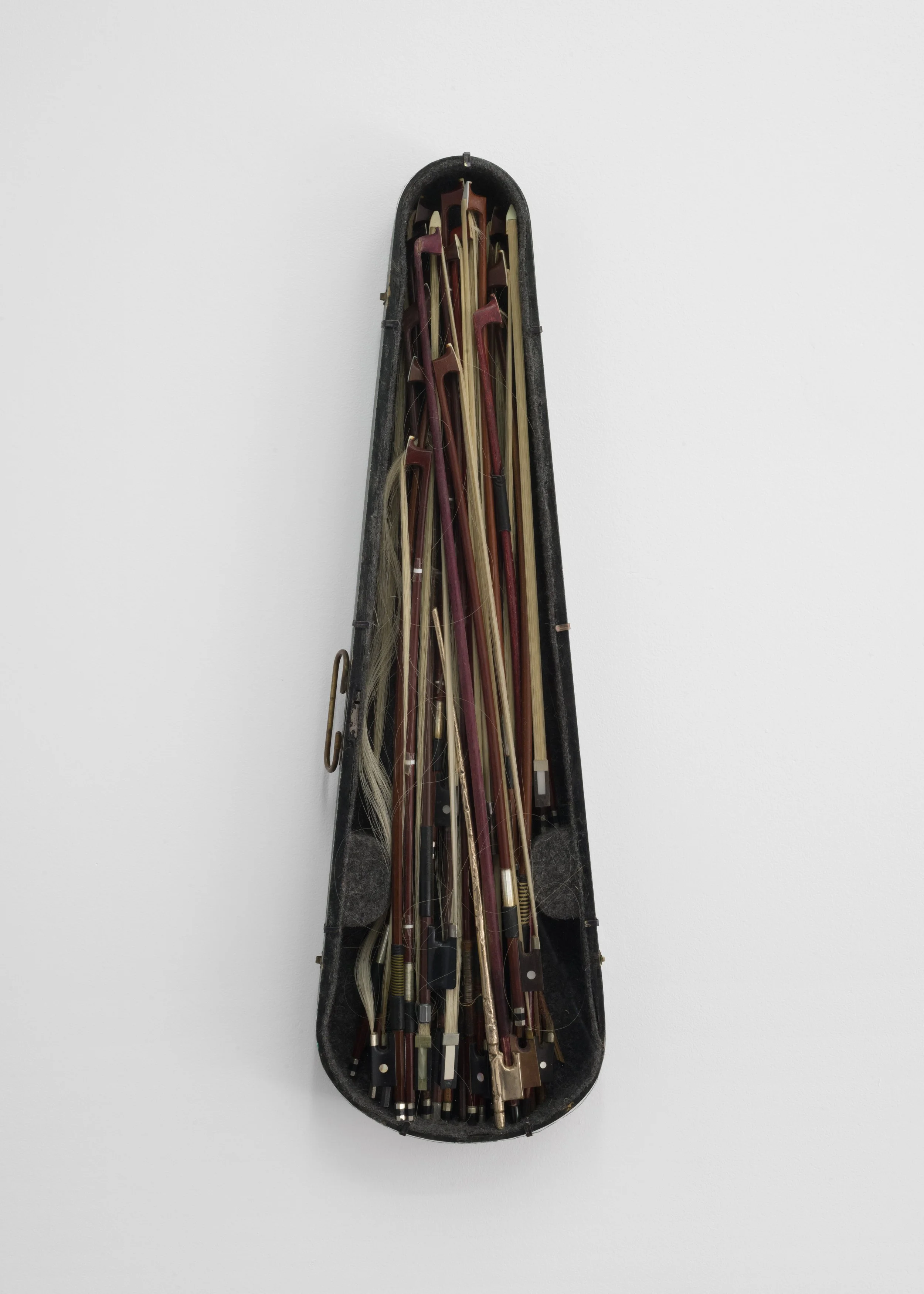
Sand takes whatever is pressed into it, and in Hébert's work I find a first proposition about absence: a form can be made entirely of what has left it. She uses old violin cases of the coffin type, worn past use, unable now to carry or protect an instrument, their velvet still holding the small things that travelled inside them, a bow, a mute, a bent bridge. The bronze takes the shape of the hollow those objects leave in the sand, and each sculpture is a presence cast from a vacancy, a negative developed into a positive, a mark left by an absent thing until the mark comes to count as the thing itself. The sand remembers what the hand forgot, and the metal, poured hot into that memory, learns to remember it too.
Second, the case holds me as an object that outlives its function. A container made to protect keeps the habit of protection long after what it protected has gone, and the coffin shape brings the grammar of burial into the open while the work declines to bury anything. Care persists as a form once its purpose has lapsed, and I read the pieces as an argument that obsolescence is an afterlife with a dignity of its own, in which the discarded becomes the keeper of memory because nothing else remains to keep it. It is the way a house in Beirut goes on holding the shape of a family after the family has dispersed, its rooms still arranged around voices that no longer cross them.
Third, the glass. Cut to the contour of each case, it makes every object legible and keeps it out of reach, a surface that could crack. It stages the old distance of the thing that stays far however close it stands, and each visitor arrives at the frame as a reflection, placed inside the work as one more object held at a remove. Looking becomes an act of restraint, a wanting that learns to stay on its own side of the pane, and the ethical weight of the room gathers there, in the small and difficult discipline of not reaching.
Fourth, the sound that never arrives. Twenty-two bows tangle into a knot too dense to draw a chord, and still the knot recalls an orchestra with its arms raised in the second before the downbeat, the whole room breathing in and nothing yet breathed out. Potentiality is most itself when it keeps the capacity not to be actualised, and these sculptures hold that condition steadily, mute and charged, a music whose force lies in remaining possible. I find in them the unplayed note as a full event, a way of standing at the threshold that asks nothing of the future except that it stay open.
— Text by Joyce Joumaa
-
Stéphanie Alèxe Hébert is an artist working in sculpture, installation, performance, photography, writing, and sound. Her practice primarily involves collecting and replicating objects which allude to sound, such as bells, instrument cases, or choir chairs. Lately, her work has been focused on collecting old and broken violin cases, specifically violin coffin cases which innately personify the objects that nestle inside of them. She then casts bronze object-oriented sculptures directly into their parameters. The objects that accompanied the cases previously become implicated as their primary residents, burrowing themselves further into their lining and reconfiguring the logic of the cases' interior. Sound becomes present in her practice as a material that emerges from anticipation, while the sculptures remain still and silent.
Hébert is based in Tiohtià:ke/Montreal and holds a BFA in Studio Arts from Concordia University and has studied at Bauhaus University in Germany. She has participated in local residencies at Céline Bureau and Atelier La Coulée. Her recent exhitbitions include The Sea After the Sun at Celine Bureau, A Set of Favours at Fais-Moi l’Art, Receptacle at Les Forges de Montreal, and Solresol at Ermitage. She is currently preparing for a duo exhibition with Léo Grenier at Galerie Carrefour.